
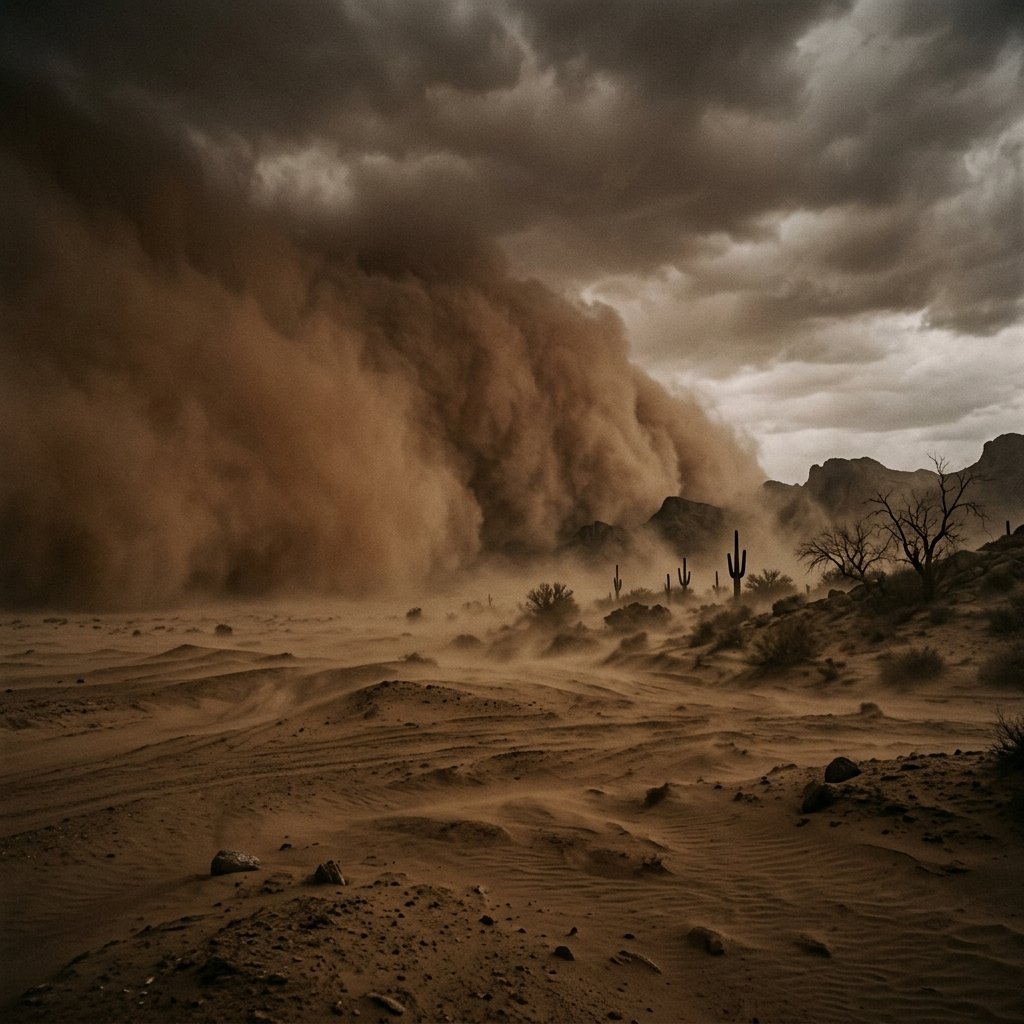

Dust storm are powerful meteorological events caused by high winds lifting loose soil and sand particles into the atmosphere. They pose serious health risks—particularly to the respiratory system—and can devastate agriculture, disrupt transportation, and damage infrastructure. Understanding what triggers dust storms and how to prepare for them can significantly reduce their impact on your health and safety.
Every year, an estimated 2 billion tons of dust are swept into the Earth’s atmosphere, according to NASA. Some of that dust travels thousands of miles across continents and oceans. While a thin haze of airborne particles might seem harmless, a full-scale dust storm is an entirely different phenomenon—a wall of sand and debris that can reduce visibility to near zero in seconds.
Dust storms have reshaped entire landscapes, buried cities, and contributed to long-term environmental degradation. The American Dust Bowl of the 1930s turned millions of acres of farmland into a barren wasteland, displacing hundreds of thousands of people. Yet despite their historical and ongoing impact, many people remain underprepared for these events.
This post breaks down exactly what causes dust storms, the many ways they affect human health, ecosystems, and economies, and what you can do before, during, and after a dust storm to stay safe. Whether you live in a dust-prone region or are simply looking to understand one of nature’s most dramatic weather events, this guide covers everything you need to know.
What Causes Dust Storms?
What atmospheric conditions trigger dust storm formation?
Dust storm form when strong winds pick up loose, dry particles of soil, sand, or silt from the ground surface. Three core conditions must align: a sufficient supply of fine, dry, loose particles; minimal vegetation or moisture to anchor those particles; and wind speeds strong enough to lift them.
The threshold wind speed needed to lift dust particles is typically around 20–25 miles per hour (32–40 km/h) at the surface. Once airborne, particles create a self-sustaining process—falling grains dislodge more particles on impact, a mechanism known as saltation.
How does wind speed and direction influence dust storm development?
Wind direction determines how far and where a storm travels. Prevailing winds can carry fine dust particles thousands of miles from their source—Saharan dust, for example, regularly reaches the Caribbean and the southeastern United States. Wind speed, on the other hand, determines the storm’s intensity. Stronger winds lift heavier particles and push the storm wall higher, sometimes reaching altitudes of several kilometers.
Which geographical regions are most prone to dust storms?
Dust storms occur most frequently in the world’s arid and semi-arid regions. The major global “dust belts” include:
- The Sahara Desert and Sahel region (North Africa)
- The Arabian Peninsula and Middle East
- Central Asia, including parts of Iran, Afghanistan, and Kazakhstan
- The southwestern United States, particularly Arizona, New Mexico, and Texas
- Australia’s outback
- China’s Gobi Desert
These regions share key characteristics: low annual rainfall, sparse vegetation cover, and extensive exposed soil.
How does climate change affect dust storm frequency?
Climate change is altering dust storm patterns globally. Prolonged droughts, desertification, and reduced vegetation cover are expanding the zones where dust storms can form. According to the United Nations Environment Programme (UNEP), land degradation driven by human activity is making more than 25% of the world’s land susceptible to dust generation. As global temperatures rise and precipitation patterns shift, scientists expect dust storm frequency and intensity to increase in many regions.
Types of Dust Storms
What is a haboob, and where do haboobs occur?
A haboob is a specific type of dust storm characterized by a towering, dense wall of dust—sometimes reaching heights of over 1,500 meters (nearly a mile). Haboobs are triggered by the outflow winds ahead of collapsing thunderstorm cells. As the storm’s downdraft hits the ground, it pushes a surge of air outward at high speed, scooping up dust in its path.
Haboobs are most common in Sudan, Saudi Arabia, and the American Southwest—particularly Phoenix, Arizona, which experiences haboobs regularly during monsoon season. They can arrive with little warning and reduce visibility to zero within minutes.
What are derecho-associated dust storms?
A derecho is a widespread, long-lived wind storm associated with a fast-moving band of severe thunderstorms. When a derecho sweeps across dry, exposed terrain, it can generate massive dust storms across a broad area. These events are particularly dangerous due to their speed and scale. A notable example occurred in July 2011, when a derecho-generated dust storm swept across the Great Plains, impacting multiple U.S. states simultaneously.
How do local and regional dust storms differ?
Local dust storms are smaller in scale and typically confined to a specific area, often caused by surface heating creating localized wind bursts. These are common in desert fringes and agricultural zones with exposed soil. Regional dust storms, by contrast, can cover entire countries or continents. The differences are largely a matter of wind system size and the availability of loose material—but even local dust storms carry significant health and visibility risks for those in their path.
Effects and Impacts of Dust Storms
What are the health effects of dust storms on humans?
Dust storms carry fine particulate matter—including PM2.5 and PM10 particles—that penetrates deep into the respiratory system. Short-term exposure can cause coughing, wheezing, eye irritation, and aggravated asthma. Prolonged or repeated exposure is linked to more serious conditions, including chronic bronchitis and reduced lung function.
Dust storms can also carry biological agents—fungal spores, bacteria, and viruses—across large distances. In the southwestern United States, dust storms have been associated with valley fever (coccidioidomycosis), a fungal lung infection caused by inhaling spores of Coccidioides fungi disturbed from the soil. According to the Centers for Disease Control and Prevention (CDC), valley fever cases have risen significantly in recent decades, partly attributed to increased dust storm activity.
How do dust storms affect air quality and visibility?
A severe dust storm can raise particulate matter concentrations to levels hundreds of times above safe air quality thresholds. The World Health Organization (WHO) recommends a 24-hour mean concentration for PM10 of no more than 45 µg/m³—during a major dust storm, levels can exceed 2,000 µg/m³. Visibility can drop to near zero, grounding flights, closing highways, and bringing entire cities to a standstill.
What are the agricultural and economic consequences of dust storms?
Agriculture bears some of the heaviest losses from dust storms. Topsoil erosion strips away nutrient-rich surface layers that crops depend on, while abrasive particles damage plant tissue and irrigation systems. The 1930s Dust Bowl stripped an estimated 100 million acres of farmland across the U.S. Great Plains, contributing to economic collapse across an already Depression-stricken nation.
Today, dust storms continue to cost billions in agricultural losses annually. In China, storms from the Gobi Desert deposit dust across farmland, contaminate water supplies, and damage crops. Economic costs extend to transportation delays, increased healthcare expenditure, and infrastructure repairs.
How do dust storms impact wildlife and ecosystems?
Dust storms affect ecosystems in complex ways. On one hand, dust deposits—particularly from the Sahara—carry iron-rich minerals that fertilize ocean phytoplankton and rainforest soils. On the other hand, heavy dust loading disrupts photosynthesis, buries habitats, and causes respiratory distress in wildlife. Coral reefs in the Caribbean have been linked to dust-borne pathogens originating in African soils, highlighting just how far the ripple effects can reach.
Dust Storm Safety Tips
How should you prepare for a dust storm before it arrives?
Preparation significantly reduces the risks associated with dust storms. Key steps include:
- Monitor weather alerts from the National Weather Service or your regional meteorological authority
- Assemble an emergency kit with N95 or higher-rated face masks, goggles, a supply of clean water, and medications for respiratory conditions
- Seal gaps around windows and doors with wet towels or weatherstripping to reduce dust infiltration
- Secure loose outdoor objects that could become airborne hazards
- Create a communication plan with household members, especially for children and elderly individuals
What should you do during a dust storm?
If a dust storm hits while you are outdoors, move indoors immediately or shelter in a hard-sided vehicle. Avoid seeking shelter under bridges or overpasses—wind tunnel effects can intensify there. If driving:
- Pull off the road as far as possible
- Turn off your headlights and engage your parking brake
- Stay in the vehicle with windows closed
Outdoors, cover your nose and mouth with an N95 mask or a damp cloth. Protect your eyes with goggles. Avoid rubbing your eyes, as particles can cause corneal abrasions.
What steps should you take after a dust storm?
Post-storm cleanup carries its own risks. Disturbing settled dust can re-suspend particles in the air. Recommended steps include:
- Wear a mask while cleaning up outdoors
- Damp-wipe surfaces rather than dry sweeping, which re-suspenses dust
- Change HVAC filters promptly to restore indoor air quality
- Seek medical attention if you experience persistent coughing, difficulty breathing, or eye irritation
- Monitor air quality using tools like Air Now (airnow.gov) before resuming outdoor activities
How can vulnerable populations protect themselves from long-term dust storm risks?
People with asthma, chronic obstructive pulmonary disease (COPD), cardiovascular conditions, or compromised immune systems face elevated risks. Long-term protective strategies include investing in high-efficiency air purifiers with HEPA filtration, consulting healthcare providers about personalized dust exposure plans, and relocating temporarily during severe dust seasons in high-risk regions.
Dust Storms Around the World
What are some of the most significant dust storms in history?
Several dust storms stand out for their scale and human impact:
- The American Dust Bowl (1930s): A decade-long series of dust storms across the Great Plains, caused by severe drought and poor farming practices. At its peak, “Black Blizzards” reached the U.S. East Coast and darkened skies over Washington, D.C.
- The Black Sunday Storm, April 14, 1935: One of the most severe single storm events of the Dust Bowl era, with a dust wall estimated at 8,000 feet high sweeping across Oklahoma and Texas.
- The 2021 Saharan Dust Event: An unusually large plume of Saharan dust crossed the Atlantic, reaching the Gulf of Mexico and Southeastern U.S., reducing air quality to “very unhealthy” levels across multiple states.
- Chinese Yellow Dust Events: Each spring, storms from the Gobi and Taklamakan deserts carry massive dust clouds over China, Korea, and Japan. A March 2021 event pushed PM10 levels in Beijing to over 8,000 µg/m³—nearly 180 times the WHO guideline.
How do dust storms differ across global regions?
The character of a dust storm varies by region. Saharan haboobs tend to be tall, red-brown walls of iron-rich particles. Central Asian storms often carry toxic residues from dried Aral Sea sediments—contaminated with pesticides and salt from decades of agricultural diversion. Australian “red dust” events carry fine iron oxide particles that can blanket entire cities. Each regional variation reflects the local geology, land use patterns, and prevailing wind systems—which is why dust storm preparedness must be tailored to specific environments.
Stay Prepared, Stay Safe
Dust storms are among the most underestimated natural hazards on the planet. They arrive fast, hit hard, and leave lasting consequences for health, agriculture, and the environment. The science is clear: as land degradation and climate-driven drought expand globally, the frequency and severity of dust storms will continue to rise.
The good news is that preparation works. Knowing your region’s dust storm season, maintaining an emergency kit, and understanding the steps to take before, during, and after a storm can meaningfully reduce risk for you and your household.
For ongoing dust storm monitoring and air quality alerts, bookmark these resources:
- Air Now (airnow.gov) — U.S. air quality index monitoring
- NOAA National Weather Service (weather.gov) — U.S. storm alerts
- WMO Sand and Dust Storm Warning Advisory (sds-was.aemet.es) — Global dust forecasting
- NASA Worldview (worldview.earthdata.nasa.gov) — Satellite imagery of dust events worldwide
Frequently Asked Questions About Dust Storms
What is a dust storm?
A dust storm is a meteorological event in which strong winds lift large quantities of sand, soil, or silt into the atmosphere, forming a dense cloud that reduces visibility and degrades air quality. Dust storms occur most frequently in arid and semi-arid regions and can travel thousands of miles from their source.
How long do dust storms typically last?
Most dust storms last anywhere from a few minutes to several hours. Large regional events, however, can persist for days and travel across continents. Duration depends on the strength of the driving wind system and the supply of available loose material.
Are dust storms dangerous to breathe in?
Yes. Dust storms carry fine particulate matter (PM2.5 and PM10) that can penetrate deep into the lungs and bloodstream. Short-term exposure causes respiratory irritation; repeated or prolonged exposure is linked to chronic lung disease, cardiovascular conditions, and fungal infections like valley fever.
Can you drive in a dust storm?
Driving in a dust storm is extremely dangerous due to near-zero visibility. The recommended approach is to pull completely off the road, turn off headlights and engine, engage the parking brake, and remain inside the vehicle until the storm passes.
What is the difference between a sandstorm and a dust storm?
The terms are often used interchangeably, but there is a technical distinction. Sandstorms carry heavier, coarser sand particles that typically remain within a few meters of the ground. Dust storms carry finer particles that can rise kilometers into the atmosphere and travel much greater distances. Both pose health and visibility risks.
How can I monitor dust storm activity in my area?
In the United States, NOAA’s National Weather Service issues dust storm warnings and advisories. The Air Now platform (airnow.gov) provides real-time air quality data. Globally, the WMO Sand and Dust Storm Warning Advisory and Advisory System (SDS-WAS) provides forecasting and monitoring tools.