
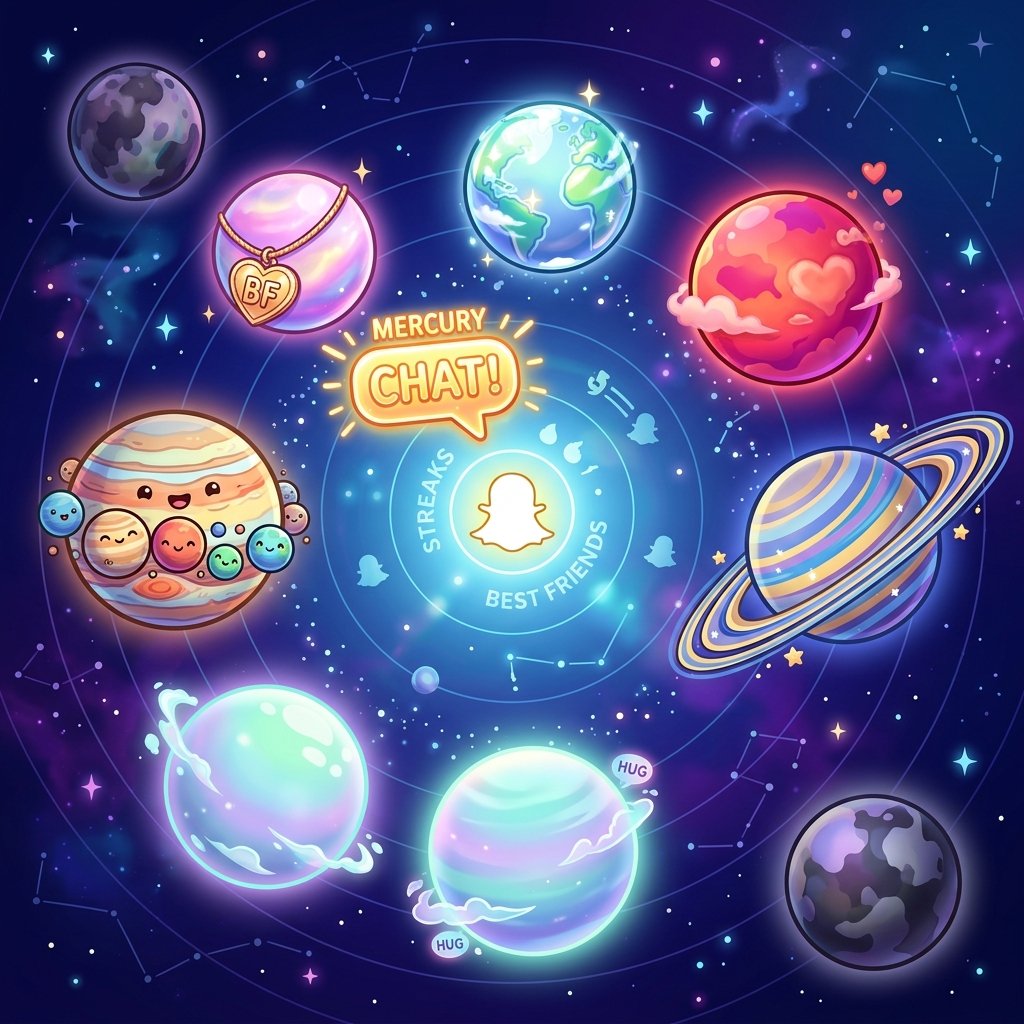

The Snapchat Solar System is a viral social media trend where users assign planets to the people in their lives based on closeness—Mercury for the person they text most, Neptune for someone they love deeply, and so on. Each planet holds a symbolic meaning that reflects your real-world relationships.
If you’ve recently seen “Snapchat Solar System” trending on TikTok or Twitter, you’re not alone. The concept exploded across Gen Z social media in 2023 and has continued to spark conversations about friendships, crushes, and digital relationships ever since.
At its core, the Snapchat Solar System is a fun, self-reflective exercise. Users map out the people in their lives by assigning each one a planet—from Mercury (your closest contact) to Pluto (someone you’re still figuring out). The result is a personalized “solar system” that visualizes your social circle in a way that feels intuitive, relatable, and surprisingly revealing.
This guide breaks down everything you need to know: what the trend is, what each planet means, why it went viral, how to create your own solar system, and—importantly—how to do it safely.
What Is the Snapchat Solar System?
The Snapchat Solar System is a user-created trend (not an official Snapchat feature) in which people rank the individuals in their lives using the planets of our solar system as a metaphor for closeness. The closer a planet is to the Sun, the closer that person is to you.
The trend gained traction on TikTok and Snapchat in 2023, with users sharing their own solar systems through Stories, DMs, and video content. Thousands of creators posted videos reacting to where they landed in their friends’ solar systems—sparking conversations, debates, and even a few dramatic reveals.
Unlike algorithmic features built into the app, this trend is entirely user-driven. You decide who belongs where. That personal agency is a big part of what makes it resonate.
The Snapchat Solar System Planet Order Explained
Here’s a full breakdown of each planet and what it symbolizes in the Snapchat Solar System framework:
Mercury — The person you text most
Mercury is the planet closest to the Sun, and in this context, it represents the one person you communicate with more than anyone else. This is your go-to contact—the person who gets the first “good morning” text and the last “good night.”
Venus — Your best friend
Venus holds the second spot and is typically reserved for your closest best friend. This is someone you trust completely, someone who knows your secrets and still shows up.
Earth — Yourself
Earth sits third in the solar system, and in this trend, it represents you. You are the center of your own universe—the reference point around which everyone else orbits.
Mars — Your crush
Mars takes the fourth position and symbolizes your crush or someone you have romantic feelings for. The red planet has long been associated with passion and desire, making it a fitting choice.
Jupiter — Your best friend group
Jupiter is the largest planet in our solar system, and here it represents the bigger picture: your core friend group. These are the people who make up your social foundation—your squad, your crew, your ride-or-dies.
Saturn — People you’ve kissed
Saturn occupies the sixth spot and represents people with whom you’ve shared a physical romantic moment. The planet’s iconic rings serve as a visual metaphor for connection and intimacy.
Uranus — People you’d consider dating
Uranus sits in the seventh position and represents people you find attractive or could see yourself dating—even if nothing has happened yet. Think of it as your “maybe” romantic tier.
Neptune — People you love
Neptune, the eighth planet and the farthest official planet in our solar system, represents deep love. These are people you care about profoundly—family members, long-time friends, or past loves who still hold a meaningful place in your life.
Pluto — People you’re unsure about
Pluto rounds out the list in the ninth spot. Though no longer classified as a full planet by NASA (it was reclassified as a “dwarf planet” in 2006), its inclusion here is intentional. Pluto represents the people you’re still figuring out—acquaintances, complicated relationships, or someone you’re not quite sure where to place.
Why Did the Snapchat Solar System Trend Go Viral?
Several factors converged to make this trend explode across social media platforms.
The connection to astrology and zodiac culture
Gen Z has driven a massive resurgence of interest in astrology. According to a 2022 survey by the American Psychological Association, nearly 30% of American adults believe in astrology—and among younger generations, that number skews even higher. The Snapchat Solar System taps into this same impulse: the desire to find symbolic systems that help explain human relationships.
It’s interactive and deeply personal
Most viral trends succeed because they invite participation. The Snapchat Solar System is no different—but it goes a step further by making the content intensely personal. Assigning your crush to Mars or your best friend to Venus turns abstract emotions into something concrete and shareable.
The drama factor
Part of the trend’s appeal is the social tension it creates. Where did your friend rank you in their solar system? Did they put you as Mercury—or all the way out at Pluto? These questions generate real emotional reactions, which translates into more shares, more comments, and more engagement.
Comparison to other Snapchat trends
The Snapchat Solar System follows a long tradition of relationship-ranking trends on the platform, similar to Snapchat’s own “Best Friends” and “Snap Streaks” features. Those official features already gamified friendships; this trend simply extends that logic into user-generated territory.
How to Create Your Own Snapchat Solar System
Creating your Snapchat Solar System is straightforward. Here’s a step-by-step guide:
Step 1: Start with Mercury. Think about who you communicate with the most across all platforms—texts, Snaps, DMs. That person gets the first planet.
Step 2: Work outward. Move through the remaining planets in order, assigning people based on your current closeness and the symbolic meaning of each planet. Don’t overthink it—your gut instinct is usually accurate.
Step 3: Remember Earth is you. The third planet represents yourself, so skip it when assigning others. It’s a reminder that you are the center of your own world.
Step 4: Include Pluto for the “gray areas.” If there are people in your life you can’t quite categorize, Pluto is the right fit. There’s no shame in having a Pluto tier.
Step 5: Share it (or keep it private). Some people share their solar systems on their Snapchat Story or TikTok. Others keep it entirely private as a personal reflection exercise. Both are valid.
Tips for updating your solar system:
- Revisit your list every few months. Relationships shift, and your solar system should reflect that.
- Avoid assigning planets based on who you want to be close to—this works best as an honest snapshot.
- If you’re sharing publicly, consider using initials or nicknames instead of full names.
Common mistakes to avoid:
- Placing too many people in the Mercury and Venus tiers—true closeness is rare.
- Forgetting that Earth represents you and accidentally assigning it to someone else.
- Treating the list as permanent. It’s meant to be fluid.
Privacy and Safety Considerations
Before you share your Snapchat Solar System publicly, there are some important things to keep in mind.
Don’t share identifying information. If your solar system includes a crush or someone from a complicated relationship, sharing their name publicly—even on a private account—can create unintended consequences. Use initials or descriptors instead.
Be mindful of what you post. Once content is shared on social media, it’s difficult to fully retract. Screenshots travel fast, especially if your account is public or your content gets reposted.
Protect your mental health. Ranking relationships can sometimes surface uncomfortable feelings—jealousy, insecurity, or sadness about a friendship that’s faded. Approach the exercise with self-compassion. It’s a fun trend, not a definitive judgment of your social worth.
Talk to younger users about digital boundaries. For parents and educators: this trend is popular among teenagers. It’s worth having an open conversation about the difference between sharing for fun and oversharing personal relationship details online.
Privacy settings matter. Before posting anything related to this trend, check that your Snapchat and social media privacy settings reflect who you actually want seeing your content.
Participating Responsibly in Social Media Trends
The Snapchat Solar System is, at its heart, a lighthearted way to reflect on the relationships that matter most to you. Its staying power comes from a simple truth: people are endlessly fascinated by how they connect with others, and any tool—planetary or otherwise—that helps visualize that resonates.
Social media trends like this one play a genuine role in digital culture. They create shared language, spark real conversations, and sometimes even strengthen friendships. The person who discovers they’re someone’s Mercury might feel more valued than they ever expected.
That said, the best approach is a thoughtful one. Use the trend as a personal reflection tool first, a social sharing moment second. Be honest with yourself about your relationships, protect the privacy of the people you include, and remember that no ranking system—not even one modeled on our solar system—can fully capture the complexity of a human relationship.
The planets are a metaphor. The connections are real.
Frequently Asked Questions
What is the Snapchat Solar System?
The Snapchat Solar System is a viral social media trend where users assign planets to people in their lives based on closeness. Mercury represents the person you text most, while Pluto represents someone you’re unsure about. Each planet carries a distinct symbolic meaning tied to the nature of that relationship.
Is the Snapchat Solar System an official Snapchat feature?
No. The Snapchat Solar System is a user-generated trend, not an official feature built into the Snapchat app. It originated organically on social media platforms like TikTok and Snapchat Stories.
What does each planet mean in the Snapchat Solar System?
Mercury = person you text most; Venus = best friend; Earth = yourself; Mars = your crush; Jupiter = your friend group; Saturn = people you’ve kissed; Uranus = people you’d date; Neptune = people you love; Pluto = people you’re unsure about.
Why did the Snapchat Solar System go viral?
The trend went viral because it combines the popularity of astrology and symbolic systems with a highly personal, shareable format. Gen Z’s affinity for relationship-based social content—and the drama of discovering where you rank in someone’s solar system—drove widespread engagement.
Is it safe to share your Snapchat Solar System publicly?
It can be, with precautions. Avoid using full names, check your privacy settings before posting, and be mindful of the personal information you’re sharing—especially if your solar system includes a crush or someone from a complicated relationship.
What does Pluto mean in the Snapchat Solar System?
Pluto represents people you’re uncertain about—acquaintances, complicated relationships, or anyone who doesn’t quite fit into the other categories. Its status as a “dwarf planet” makes it a fitting metaphor for those in-between relationships.