
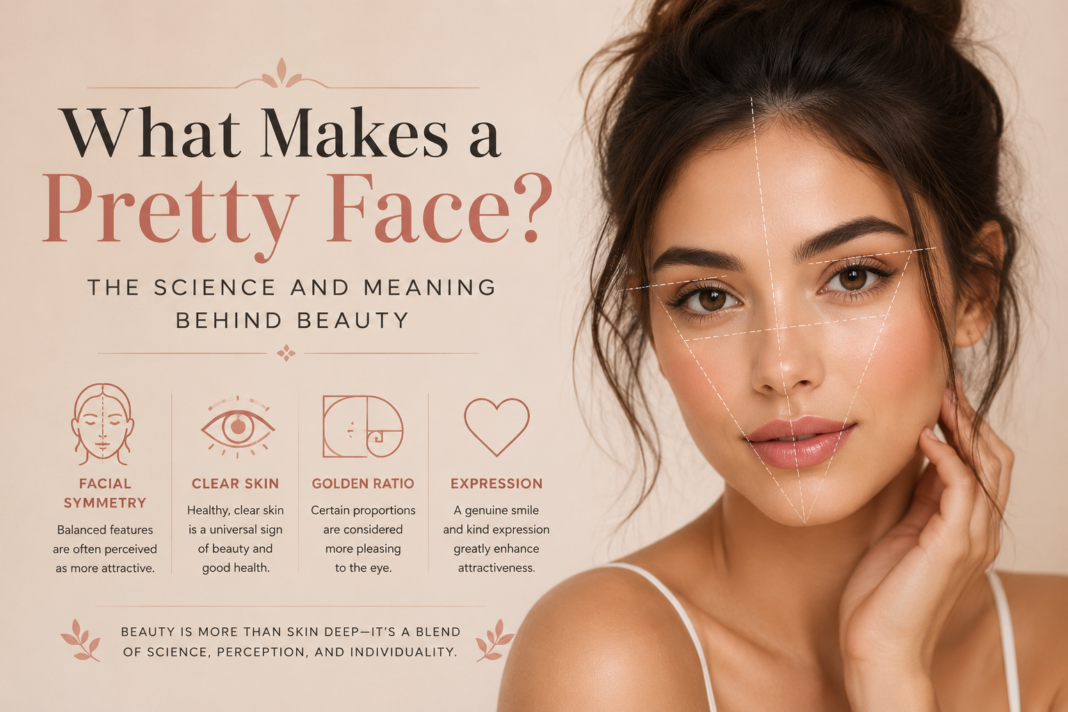

A “pretty face” is shaped by biology, culture, and psychology working together. Evolution draws us to symmetry and health cues, culture sets shifting standards, and our minds attach meaning to attractiveness through effects like the halo effect. True appeal also includes character, well-being, and authenticity.
Few ideas capture human attention quite like beauty. We notice a pretty face in a crowd, on a screen, or in a painting—often before we register anything else about a person. Yet the phrase “pretty face” hides surprising depth. It isn’t only about smooth skin or balanced features. It reflects millions of years of evolution, centuries of cultural change, and the quiet psychology that shapes how we judge one another.
This post breaks down what actually makes a face appealing. You’ll learn why your brain responds to certain features, how beauty standards have shifted across history, and how attractiveness influences the way people are treated. We’ll also look at the deeper side of beauty—character, health, and confidence—and ask where the idea is heading in a digital age full of filters and virtual influencers.
By the end, you’ll see the “pretty face” not as a single fixed standard, but as a moving target shaped by nature, society, and personal meaning.
Why are humans so fascinated by beauty?
Beauty grabs attention because our brains are wired to respond to it. Studies in neuroscience show that viewing an attractive face activates the brain’s reward centers, similar to other pleasurable experiences. This response is fast, often happening before we consciously think about it.
But fascination with beauty is also social. We use faces to read emotion, trust, and intent. A face we find pleasing can feel safer or more familiar. That mix of instinct and social learning explains why beauty feels both deeply personal and oddly universal.
It helps to separate two things: the biological pull toward certain features, and the cultural ideals layered on top. Both shape what we call a “pretty face,” but they work in different ways.
The biological blueprint: why we’re drawn to certain faces
What facial features signal health and good genes?
Evolutionary psychology suggests we’re drawn to features that historically signaled health and fertility. Three patterns appear again and again in research:
- Symmetry: Faces with balanced left and right sides tend to be rated as more attractive. Researchers link facial symmetry to developmental stability—a sign that a person grew without major genetic or environmental stress.
- Averageness: Faces close to the mathematical average of a population are often judged as more appealing. Averageness can signal genetic diversity and a lack of unusual traits, which feels reassuring to the brain.
- Hormonal markers: Features shaped by estrogen and testosterone act as cues. Softer features are often associated with estrogen, while a stronger jaw can be linked to testosterone. These cues can hint at age and reproductive health.
None of this means symmetry or averageness guarantee attraction. They simply nudge perception in predictable directions.
How does the brain respond to a pretty face?
When people view faces they find attractive, brain imaging studies show increased activity in reward-related regions. Chemical messengers play a role here too. Dopamine is tied to the sense of reward and motivation, while oxytocin is linked to bonding and social connection. Together, these systems help explain why an appealing face can feel almost magnetic.
Are beauty preferences the same across cultures?
Some preferences appear nearly universal. Symmetry, clear skin, and signs of health are valued in many different societies. But culturally specific ideals layer on top of these shared markers. What counts as the “ideal” nose, skin tone, or face shape can vary widely from one place to another. So beauty has a common foundation, with cultural details built on top.
The cultural kaleidoscope: how beauty standards shift
How have beauty standards changed throughout history?
Beauty has never sat still. Each era rewrote the rules.
- Ancient civilizations: In Egypt, dramatic eye makeup and adornment signaled status and beauty. Greek and Roman ideals emphasized proportion and harmony, reflecting their broader love of balance and order.
- Renaissance to Victorian era: Renaissance art celebrated fuller figures and soft features as signs of wealth and fertility. By the Victorian era, ideals shifted again toward modesty, pale skin, and restraint.
- 20th and 21st centuries: Mass media, global travel, and the internet broadened and blended ideals. Today, beauty standards are more diverse than ever, though still heavily shaped by what circulates online.
This history matters because it shows that no single “pretty face” has ever been permanent. The standard is always being rewritten.
How does media shape what we find beautiful?
Media both reflects and creates beauty ideals. Film, television, and advertising have long promoted specific looks, repeating them until they feel like the norm.
Social media accelerated all of this. Filters can reshape a face in seconds. Influencers set trends that spread globally within days. The result is a “digital ideal”—a polished, often edited version of beauty that can be hard to separate from reality. For many people, especially younger users, this constant stream of curated images becomes the backdrop against which they judge their own faces.
How do art and storytelling shape beauty?
Beauty has always lived in art, literature, and folklore. Painters, poets, and storytellers have shaped how we picture an ideal face. Cultural values feed directly into these portrayals—what a society admires tends to show up in how it depicts beauty. Over time, these stories reinforce certain ideals and quietly pass them to the next generation.
The psychology of a pretty face
What is the halo effect, and why does it matter?
The halo effect describes a powerful bias: when we find someone attractive, we tend to assume they have other positive traits too. People rated as good-looking are often perceived as more intelligent, kinder, and more competent—even without any evidence.
This bias shows up in real situations. It can shape first impressions in social settings, influence judgments in professional contexts, and affect romantic attraction. The halo effect is a reminder that a “pretty face” carries social weight far beyond appearance.
How do beauty standards affect self-image?
Constant exposure to idealized faces can shape how people see themselves. When the standard feels out of reach, self-esteem can suffer. In some cases, an intense focus on perceived flaws can contribute to body dysmorphia—a condition where someone fixates on aspects of their appearance that others may barely notice.
The pursuit of an “ideal” face can become draining, especially when that ideal keeps shifting and is often digitally enhanced.
Why do people use makeup and cosmetic enhancements?
Motivations vary. Some people use makeup to enhance features they already like. Others use it to move closer to a cultural ideal. Both can be valid.
For many, the deeper driver is confidence and self-expression. Makeup and cosmetic choices can be creative tools—ways to feel more like yourself rather than less. The line between enhancing and conforming is personal, and it differs from one individual to the next.
Beyond the surface: the deeper meaning of beauty
Can character make a face more attractive?
Yes—and most people sense this intuitively. Kindness, empathy, and warmth shape how we read a face over time. A genuine smile and an engaged expression can make someone far more appealing than features alone.
There’s also the “glow” tied to happiness and well-being. People who feel content often appear more attractive to others, not because their features changed, but because their expression and energy did.
How do health and lifestyle affect appearance?
Mind, body, and spirit show up on the face. Good sleep, hydration, nutrition, and physical activity tend to improve skin, brightness, and overall vitality. Mental state matters too—stress and exhaustion are visible, while calm and confidence read as appealing. In this sense, a pretty face is often a reflection of overall well-being.
How are beauty standards being challenged today?
A growing movement pushes back against narrow ideals. Body positivity encourages acceptance of diverse bodies and faces, while inclusivity efforts widen who gets represented in media and advertising. The goal is to redefine “pretty” so it embraces different skin tones, features, ages, and body types—rather than a single template.
The timeless appeal: why “pretty face” endures
The human desire for aesthetics isn’t fading. We’re drawn to beauty in faces, art, and nature, and that pull seems built into us. What changes is the definition, not the desire.
Authenticity is becoming central to how people define beauty. Individuality—the features that make a face distinct—is increasingly valued over a flawless, generic ideal.
What does the future of beauty look like in an AI-driven world?
Technology is reshaping the conversation. Virtual influencers—digital characters with curated, computer-generated faces—now attract real followers and brand deals. AI tools can generate “perfect” faces on demand. This raises new questions: When beauty can be manufactured pixel by pixel, what happens to authenticity? The future of the “pretty face” may hinge on how we balance digital perfection against the appeal of something real and human.
Beauty is complex—and that’s the point
A “pretty face” is never just one thing. Biology pulls us toward health and symmetry. Culture sets ever-changing standards. Psychology adds meaning, bias, and emotion. And beneath all of it, character, health, and confidence shape genuine appeal.
The most useful takeaway is this: rather than chasing a single ideal, it’s worth understanding the forces behind beauty—and deciding for yourself what feels authentic. If you want to explore further, look into the research on the halo effect, the history of beauty standards, or the growing body positivity movement. Each offers a richer view of what “pretty” really means.
Frequently asked questions
What actually makes a face attractive?
Attractiveness is influenced by a mix of factors. Biologically, symmetry, averageness, clear skin, and hormonal cues tend to be rated as appealing. Beyond biology, culture shapes specific ideals, and psychological factors—like expression, warmth, and confidence—strongly affect how attractive a face appears.
Is beauty universal or cultural?
It’s both. Some markers, such as symmetry and signs of health, are valued across many cultures. But specific ideals—preferred features, skin tone, or face shape—vary widely from place to place and shift over time.
What is the halo effect?
The halo effect is a bias where people assume attractive individuals also have other positive traits, like intelligence or kindness. It can influence first impressions in social, professional, and romantic situations, even without any supporting evidence.
Does inner beauty really affect how attractive someone looks?
Yes. Kindness, empathy, and happiness shape facial expression and energy, which strongly influence how others perceive a person. Over time, character and well-being can make someone more appealing than features alone.
How is social media changing beauty standards?
Social media spreads beauty ideals quickly and introduces filters that can reshape a face instantly. This creates a “digital ideal” that’s often edited and hard to match in real life, which can affect self-image—especially for younger users.